


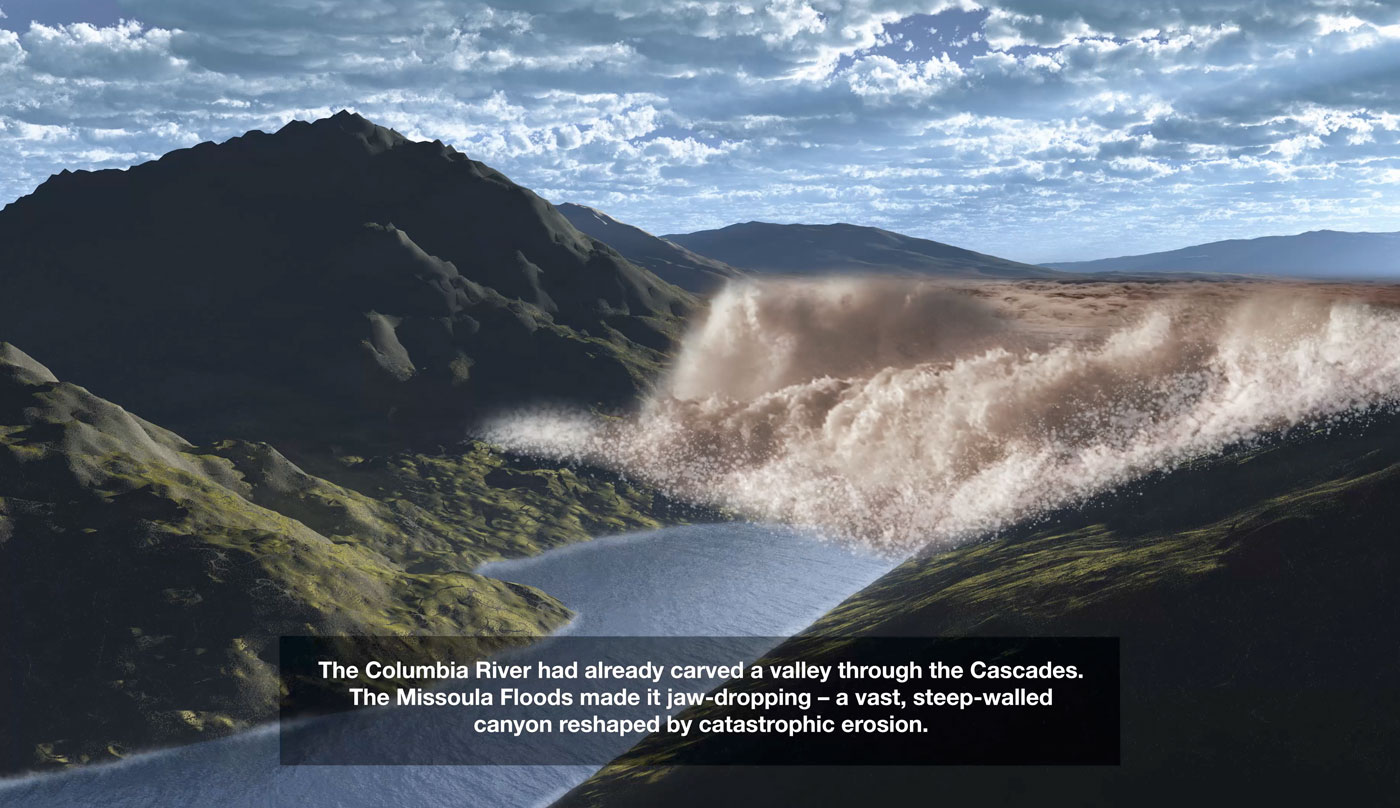
A still from Mike Bold’s animation of the Missoula Floods, the centerpiece of a new permanent exhibition at Eastern Washington University.
Mike Bold is a wizard, at least according to me. The rest of the helveticka team knows his powers all too well, having watched him jump from print design to digital animation as an employee, then working with him as a preferred vendor over the past 20 years.
The man behind Digital Itch has created slick visuals for blockbuster award shows, including the Grammys, Emmys, Tonys, and NFL Honors. His trade-show theatrics have supported mega-brands like Amazon and Microsoft. Fans of live and broadcast sporting events have seen his animations at Spokane Chiefs games and the Super Bowl halftime show alike. And he has taken on passion projects ranging from independent films to the launch of our very own Helveticahaus.
Mike’s work speaks for itself. But we are speaking about it anyway, because:
1) We’re celebrating International Animation Day.
2) With Mike’s help, helveticka recently completed an exhibition inside the new science building at Eastern Washington University, and the animated component is impressive.
Our challenge was to tell the story of the Missoula Floods, ice-age megafloods that shaped our region’s geography and geology from western Montana to the Pacific Coast. Mike’s task was to show it. No big deal. Just conjure a prehistoric world and then destroy it with water – believably and on a budget.
“Literally the hardest thing to do in 3D is water,” Mike said with a laugh as we talked about the project and the meaning of Animation Day against the backdrop of AI’s rise. He shared some bold takes (ha) about his craft and where he sees the industry going.
You started as a graphic designer in the print world. What drew you to animation?
At the time I thought print was a dying medium. My desire to start animating was on the side of, how do we make these still images move and become more dynamic? You’re able to tell more of a story that way.
Your initial immersion happened at this firm, back in the mid-’90s.
We had projects that needed animation, so I taught myself over a summer during a divorce and spent about 200 hours of overtime.
You went on to work for North by Northwest Productions, which connected you to an animation studio in LA, which led to your big break animating for the Grammy Awards. Did your design background give you any special sauce as you went for jobs?
Most animators come from the editing side. Coming from the design side, my eye was different – less utilitarian and more “pretty” animation, like I was designing a still piece every second. But that still piece might have 20 elements, and they all have to move in a way that makes sense.
Make it make sense. Design teaches you that. You have to figure out what the elements are and how they work together.
You’ve created some striking content for trade shows. Any favorites?
The biggest was an Amazon job – three or four screens stretching 150 yards, with ribbon screens in the middle that ran up onto the ceiling and down across the floor of the stage.
EWU’s Missoula Floods animation required very different techniques, in terms of re-creating landscapes and accurate geologic processes. I called you a wizard because no matter what we threw at you, you made it appear.
With so much water and not that much time, compositing was the way to go. So I created backgrounds in a 3D program and layered on images and effects. For example, you take a still frame of a river and lay video of a river on top, following the shoreline in the photo and tweaking and masking around it until the new river fits and moves naturally.
One scene of the flood wall hitting is a composite of three shots of ocean waves breaking on rocks. I looked at 20 or 30 and skewed my selections to just the right perspective. It’s very artistic and very mathematical and scientific at the same time, because you have to know how it would actually look and jump over the land and contour to it.
Any project of any considerable size is always a problem-solving thing.
Are you good at math?
I was very good at math in high school. I thought I was gonna do something with math, but senior year I said screw it and took all the art classes.
Did you ever dream of working for a big movie studio?
I did, and I was blessed enough to do a lot of LA work from here. But if you want to work for Disney, you gotta go where Disney is.
Do you recall being really struck by any animated film?
I went to the first Avatar, and I literally never watched the movie because I was so floored by the technical aspects of the animation.
Pixar movies. I’ve marveled at the fact that you’re putting so much character and liveliness into a 3D object – facial expressions, movement, comic timing – making it up from nothing. When you look at the credits on an animation like that, it’s 600 or 700 people and probably 10 different firms. This one specializes in explosions; this one specializes in water; this one specializes in background plates.
Half the time there’s way more motion in animation than live-action stuff. It’s amazing that we’ve figured out how to do it. To make a world with a computer.
What is one memorable story from your career?
My biggest claim to fame is using 27 computers over 25 days to render one 6-second scene. It was for a movie about Exodus that never came out.
What was the scene?!
Scrolling past a forest with a Mayan village in the background. There was a lot of fog so it would be really moody, and that fog was extremely slow to render. That’s why the big studios have server farms with thousands of machines just rendering constantly.
How is AI affecting your industry?
My industry is going away because of AI. It can create something in 15 minutes that would take me two months to do. It’s an acceptance of a certain standard of quality, and it’s kind of the way the world went.
We used to work with million-dollar editing systems and $500,000 cameras. The iPhone took their place. It’s the dumbing down of graphics – the dumbing down of everything. It’s similar to a record versus an MP3. There’s a ton of compression on the digital file so it’s not near as good, but it’s become the world standard.
What does that mean for you?
I’m too close to retirement to learn how to use AI. So, I’m switching to doing handmade custom woodworking. You want a speakeasy in your basement?
Yes! But are you serious?
For years I have wrestled with the idea that none of my stuff is lasting. The best example ever is this 10-second animation I did for the Tony Awards. It was in the middle of the show, going from New York City to a cruise ship in the Caribbean. I made this animation of Times Square, with the camera rolling up and back down to the ship. I worked for a month on it, and nobody ever saw it because the guy pushed the wrong button.
Building interiors, maybe some of it will stick around for a while. Earlier this year I spent five months making 17 feet of custom cabinetry with a 3-inch reclaimed barnwood countertop. I very much enjoy being in the shop after 30 years at a computer.
