


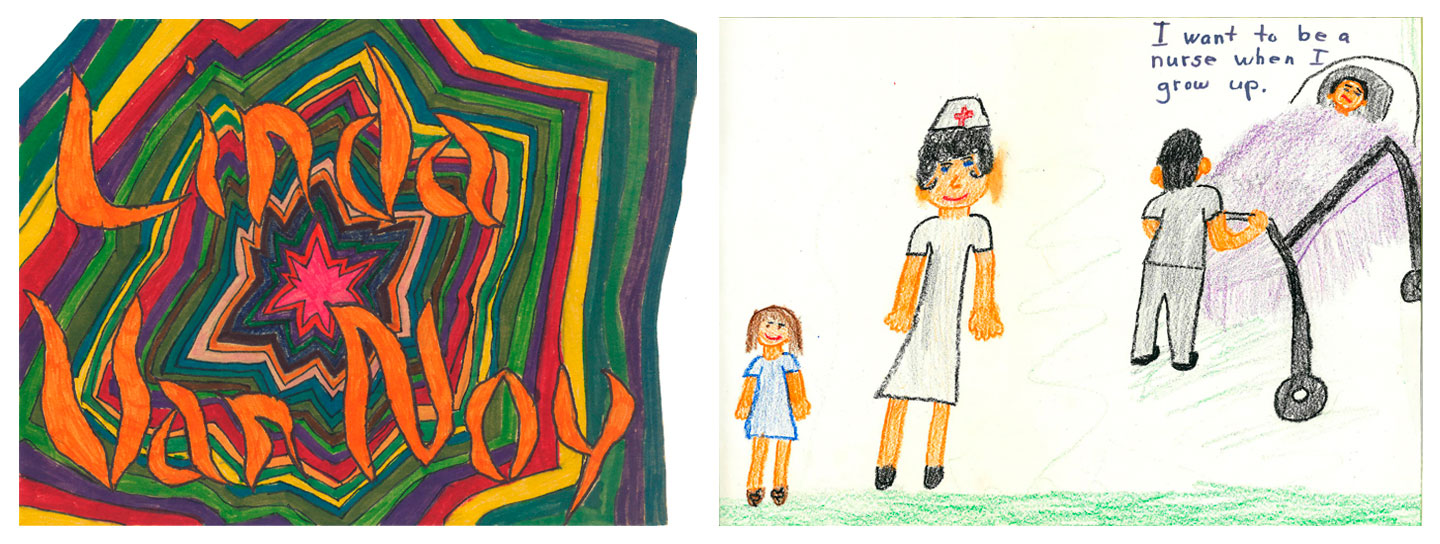
Linda’s work at age 11 (left) and age 7. She did not become a nurse.
My dad tells a story about the first time he ever bowled. No idea what he was doing, no technique, no expectations. It wasn’t a perfect game, but almost.
High with achievement, he really applied himself. He focused on form. He studied other bowlers and copied their tricks. And his score got worse. And worse. The harder he tried and analyzed and compared, the further from greatness – and fun – he got.
Why am I bringing this up in a blog about Drawing Day? Because I see a strong parallel to my experience with drawing.
As a kid, I didn’t think about making art – I just made it. Creativity blasted from my brain, and my hands shaped it without questioning if I was any good or if things looked “right.” I remember how it felt, the pure unselfconsciousness. The immediacy of how children see and interpret the world.
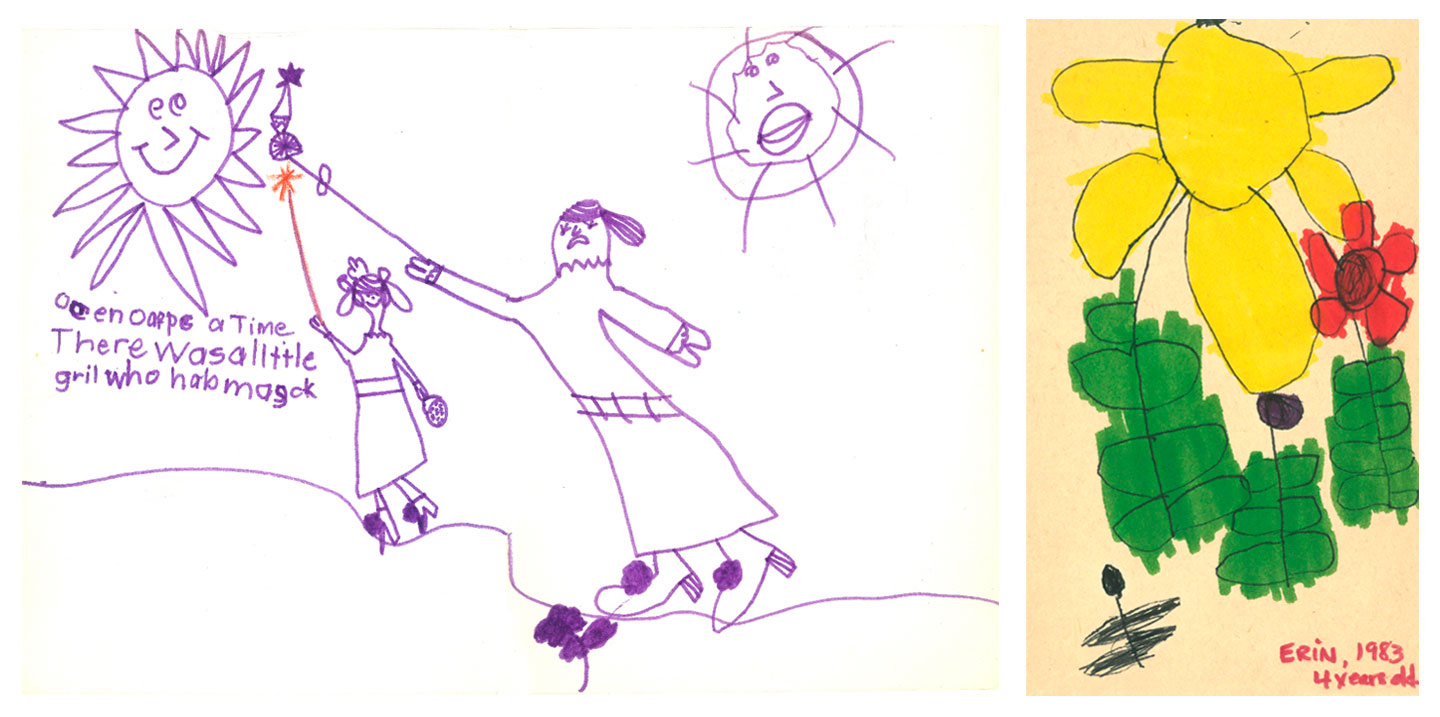
Erin’s work at age 5 (left) and 4.
Looking through my mom’s collection of my works, it struck me that my best stuff happened when I was the youngest. I did things that didn’t make sense. Freakishly long necks. Mustaches above noses. Christmas trees with ornaments only on the outline. Wacky colors, proportions, pairings.
My drawing wasn’t objectively great, but you can feel the freedom and confidence that is present in objectively great art.
Apparently, iconic modernist painter Paul Klee had a similar trip down memory lane. As reported by Forbes, he was 22 and home from art school when he discovered a pile of his childhood works in a shed behind his parents’ house. And he marveled at what he’d made as a kid under 10.
“Looking back to his childhood, Klee also found a way forward, developing a childlike aesthetic that repudiated everything that the art academy had taught him. Nobody would mistake his mature work for the naïve doodles of his youth; the influence of his past was more than mere mimicry of infancy. Most fully articulated in the Pedagogical Sketchbook he authored while teaching at the Bauhaus in the ’20s, Klee’s approach to art derived from the imaginative capacity to embody what he drew, even something as abstract as a line or an arrow. By some kind of sympathetic magic, Klee temporarily became whatever he put on paper or canvas,” reads the Forbes article, which covered a 2022 exhibition at the Institute of Contemporary Art / Boston.
Called To Begin Again, the show investigated “the agency of children and the influence of their art, language, gestures, needs, power, and vulnerability on visual artists.”
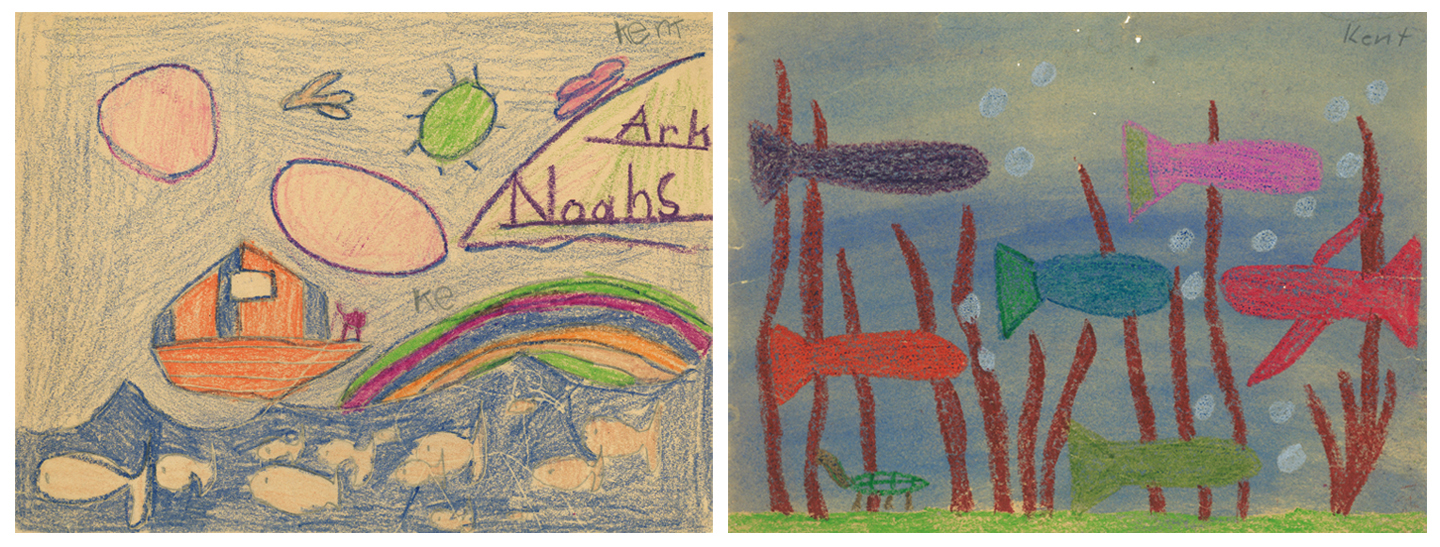
CK’s work in early elementary school.
Here at helveticka, we’ve been thinking about that powerful vulnerability, and digging in our archives for the artists we once were. Mine is buried deep. The visual side of my art stopped growing pretty early, because, like my father, I hate to lose. Perfectionism squashed my joy, though I’ve been finding it again doing unhinged doodles with my kids.
For CK, Linda, and Shirlee, visual art is who they are. Every day they create for others, finding the lines, shapes, colors, and perspectives to say something exact. They were born for this medium, so I wasn’t surprised to see hints of greatness in their earliest portfolios.
Linda and CK both noted perspective in their drawings. While Linda appreciated the angle of her hospital gurney and the properly oriented shoes on her orderly, CK lamented that he hadn’t realistically woven seaweed in front of his fish as well as behind.
Shirlee acknowledged she was exacting, adding that if she couldn’t do something to perfection, she wasn’t doing it at all. Drawings from her early childhood were lost with her grandmother, but she shared junior high relics that demonstrate her gift for color and ordered, systems-based thinking.
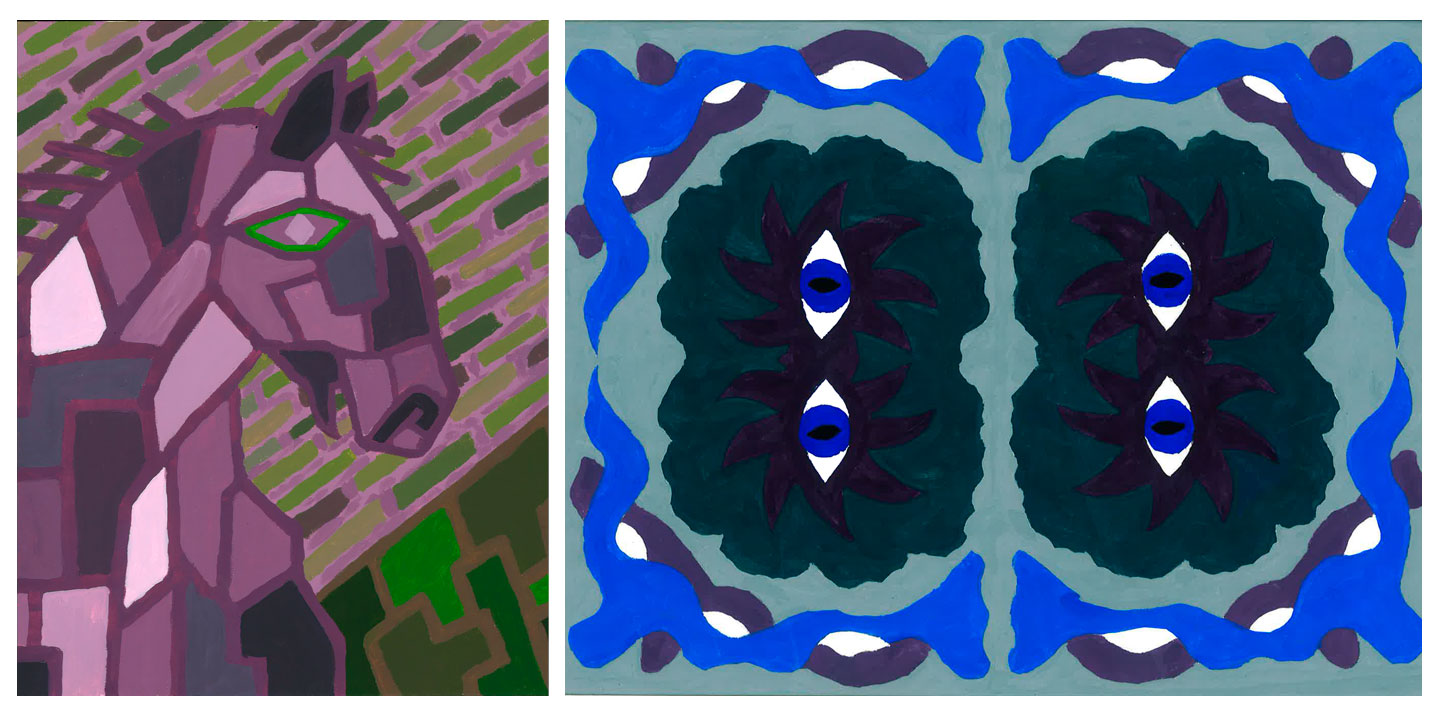
Shirlee’s work at age 13.
Surprising no one, there is weirdness in my pieces. Double suns, absurd slants, unreal size relationships, and a wonderful lack of worry about coloring outside the lines.
“The expressive lines of young children’s spontaneous drawings have fascinated artists (e.g., Picasso, Klee), psychologists, and early educators for over a century. Early-childhood drawings are valued for their creativity, immediacy, and personal or unique qualities, often viewed as less stereotypical than pictures made during elementary school,” states a 2025 paper in Early Childhood Research Quarterly about the connection between early drawing and writing. “Over the last century, children’s drawing has been variously conceptualized as a means of expression, a method of graphic problem-solving, and a mirror to their minds.”
I see all of that when CK sketches thumbnails for a project. His hand is fast. Sure. Layouts appear in his head and get channeled with finesse. That finesse was learned and baked in through decades of practice, of course. But I believe part of his genius comes from never losing the childlike ability to draw from the gut.
In that vein, check out this roundup of very early works from famous artists like Klee, Georgia O’Keeffe, Salvador Dalí, Pablo Picasso, Edward Hopper, and more.
Happy Drawing Day (May 16) to all, especially our inner children.
